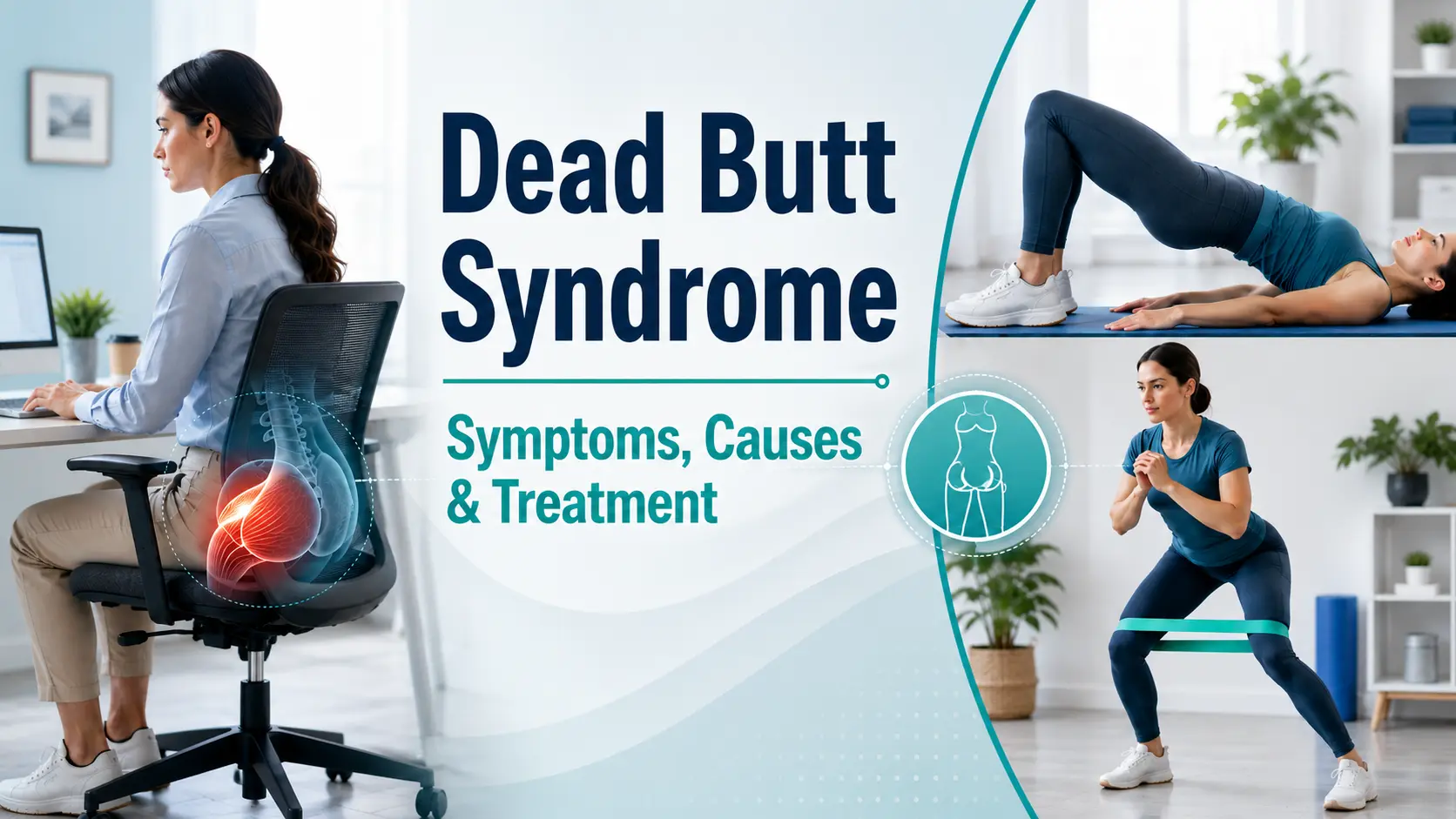
Dead Butt Syndrome (Gluteal Amnesia): Symptoms & Treatment
Learn what causes Dead Butt Syndrome, how to recognize the symptoms, and the best glute activation exercises to restore strength and improve hip health.
Written by fitnesstrainer
Certified Professional Fitness Trainer specializing in corrective exercise, strength training, and nutrition. Focused on helping individuals improve movement, reduce injury risk, and build healthier lifestyles through practical, evidence-based fitness.
Key Takeaways
- Dead Butt Syndrome (gluteal amnesia) occurs when your glute muscles become underactive, most often from prolonged sitting.[9]
- Tight hip flexors can reduce normal glute activation, leading to muscle imbalance and altered movement.[3]
- Common symptoms include lower back, hip, knee, and hamstring pain, along with reduced balance and strength.[6]
- Daily glute activation exercises can restore muscle function and improve hip stability.[4]
- Standing, walking, and strength training help prevent recurrence.[9]
What Is Dead Butt Syndrome?
Do your glutes have “amnesia”?
Dead Butt Syndrome (DBS), also called gluteal amnesia, occurs when your glute muscles stop activating properly after prolonged sitting or inactivity.[1] Although the muscles are not actually “dead,” they become underused and less effective, forcing other muscles to compensate.[5]
If you spend much of your day sitting at work, driving, or relaxing at home, your glutes may gradually forget how to fire correctly.[9] One common reason is reciprocal inhibition, where tight hip flexors from prolonged sitting reduce activation of the opposing glute muscles—particularly the gluteus medius.[3]
As a result, Dead Butt Syndrome may contribute to:
- Lower back pain[6]
- Hip pain[8]
- Hamstring tendinitis[5]
- Knee discomfort[5]
- Poor posture[5]
- Reduced athletic performance[4]
- Sciatica-like symptoms in some individuals[7]
Healthy glute strength provides the foundation for efficient movement, balance, stability, and power during everyday activities.[11]
The good news is that Dead Butt Syndrome is usually reversible. Consistent glute activation exercises, stretching, and reducing prolonged sitting can restore normal muscle function and improve overall hip health.[4]
Medical Guidelines at a Glance
| Category | Key Information |
|---|---|
| Condition | Dead Butt Syndrome (gluteal amnesia) occurs when the glute muscles become underactive, most commonly due to prolonged sitting or inactivity. |
| Common Causes | Prolonged sitting, tight hip flexors, weak glute muscles, poor movement patterns, and previous hip, knee, or lower back injuries. |
| Typical Symptoms | Lower back pain, hip pain or stiffness, hamstring tightness, knee discomfort, poor balance, difficulty climbing stairs, and reduced glute activation during exercise. |
| Who Is at Risk? | Office workers, drivers, students, frequent travelers, cyclists, and anyone who spends long periods sitting without regular movement or strength training. |
| Diagnosis | Usually based on a physical examination, movement assessment, hip strength testing, and gait or squat evaluation. Imaging is rarely needed unless another condition is suspected. |
| Recommended Treatment | Daily glute activation exercises, lower-body strengthening, hip flexor stretching, regular walking, posture improvements, and reducing prolonged sitting. |
| Recovery Time | Many people notice improved glute activation within several weeks of consistent exercise, with continued improvements over the following months. |
| Prevention | Stand or walk every 30–60 minutes, strength train the glutes 2–3 times weekly, stretch tight hip flexors, warm up before exercise, and avoid prolonged sitting whenever possible. |
| When to Seek Medical Care | Seek evaluation for severe or worsening pain, persistent numbness or tingling, progressive leg weakness, difficulty walking, symptoms that do not improve after several weeks of exercise, or loss of bowel or bladder control (medical emergency). |
Sources: Adapted from current evidence and guidance from ACSM, APTA, CDC, NIDDK, and peer-reviewed rehabilitation research.[1-10]
Understanding Your Glute Muscles
Your glutes consist of three muscles that work together to stabilize your hips and pelvis.[11]
| Muscle | Primary Role |
|---|---|
| Gluteus Maximus | Hip extension, climbing stairs, standing up |
| Gluteus Medius | Pelvic stability during walking and running |
| Gluteus Minimus | Hip stabilization and rotation |
The gluteus medius is commonly affected by Dead Butt Syndrome because it helps stabilize the pelvis with every step you take.[11] When it becomes weak, the lower back, hamstrings, and knees often compensate, increasing stress on those areas.[5]
What Causes Dead Butt Syndrome?
Several factors can contribute to gluteal amnesia.
Prolonged Sitting
Remaining seated for hours is the most common cause. Office workers, drivers, students, and frequent travelers are especially susceptible.[9]
Tight Hip Flexors
Hip flexors remain shortened while sitting. Over time, this limits hip extension and reduces glute activation.[3]
Weak Glutes
Without regular strength training, the glute muscles gradually lose strength and endurance.[4]
Poor Movement Patterns
Improper lifting technique, weak core muscles, and skipping warm-ups may reinforce faulty movement patterns.[5]
Previous Injury
Hip, knee, ankle, or lower back injuries can reduce normal glute function during recovery.[8]
Dead Butt Syndrome Symptoms
Symptoms vary but often include:[6]
- Lower back pain
- Hip pain or stiffness
- Hamstring tightness
- Hamstring tendinitis
- Knee pain
- Poor balance
- Difficulty climbing stairs
- Weakness during squats
- Reduced athletic performance
- Feeling that your glutes “won’t turn on”
Dead Butt Syndrome vs. Sciatica
Although some symptoms overlap, these are different conditions.[7]
| Dead Butt Syndrome | Sciatica |
|---|---|
| Weak glute muscles | Irritated or compressed sciatic nerve |
| Muscle imbalance | Nerve irritation |
| Hip weakness | Burning pain down the leg |
| Usually improves with strengthening | May require medical treatment |
| Numbness is uncommon | Numbness and tingling are common |
Persistent numbness, significant weakness, or pain radiating below the knee should be evaluated by a healthcare professional.[7]
How Is Dead Butt Syndrome Diagnosed?
Dead Butt Syndrome is usually diagnosed through a physical examination and movement assessment.[2] Your healthcare provider may evaluate:
- Hip strength
- Walking pattern
- Squat mechanics
- Single-leg balance
- Hip mobility
Imaging tests are generally unnecessary unless another condition is suspected.[8]
Best Exercises for Dead Butt Syndrome
Work on your glutes a little every day to combat the decline in hip health caused by a sedentary lifestyle.[4]
The following exercises help restore proper glute activation.[4] If you’re looking for a broader fitness routine, explore our diabetes exercise plan for additional strength and mobility exercises.
1. Glute Bridge
Purpose: Activates the gluteus maximus.
- Lie on your back with knees bent.
- Press through your heels and lift your hips.
- Squeeze your glutes for 2–3 seconds.
- Lower slowly.
- 2–3 sets of 10–15 repetitions[4]
2. Clamshell
Purpose: Strengthens the gluteus medius.
- Lie on your side with knees bent.
- Keep your feet together.
- Lift your top knee without rolling your hips.
- Lower with control.
- 2–3 sets of 12–15 repetitions per side[4]
3. Monster Walk
Purpose: Improves hip stability.
- Place a resistance band around your ankles or knees.
- Maintain a slight squat.
- Take slow side steps.
- 10–15 steps each direction[5]
4. Bird Dog
Purpose: Builds core stability and glute activation.
- Begin on hands and knees.
- Extend one arm and the opposite leg.
- Hold briefly.
- Return under control.
- Repeat on the opposite side.[4]
5. Bodyweight Squat
Purpose: Builds lower-body strength.
- Stand with feet shoulder-width apart.
- Lower until thighs are nearly parallel.
- Drive through your heels.
- Squeeze your glutes as you stand.[4]
Watch: Glute Activation Exercises
This video demonstrates proper glute activation techniques and complements the exercises above.[4]
Follow-Along Dead Butt Syndrome Workout
Perform this routine three to four times per week to reinforce healthy movement patterns and improve hip strength.[4]
Daily 10-Minute Glute Routine
| Exercise | Volume |
|---|---|
| Hip Flexor Stretch | 1 minute |
| Glute Bridges | 15 reps |
| Clamshells | 15 reps each side |
| Monster Walks | 20 steps |
| Bodyweight Squats | 15 reps |
| Walking | 10–15 minutes |
Consistency is more important than intensity. Even a short daily routine can improve glute activation over time.[4]
Recovery Timeline
| Time | What to Expect |
|---|---|
| Week 1 | Improved glute awareness |
| Weeks 2–4 | Better muscle activation and less stiffness |
| Weeks 4–8 | Increased hip strength and stability |
| Weeks 8–12 | Improved movement and reduced discomfort |
Recovery varies depending on activity level, muscle weakness, and consistency with exercise.[4]
Preventing Dead Butt Syndrome
Simple daily habits can reduce your risk.
- Stand and move every 30–60 minutes.
- Walk throughout the day.
- Strength train your lower body two or three times weekly.
- Stretch tight hip flexors regularly.
- Warm up before exercise.
- Maintain good sitting posture.
- Avoid remaining seated for long periods.[9]
Regular physical activity is also important for people living with diabetes because stronger muscles and consistent movement support overall mobility, balance, and long-term health.[10]
Regular exercise also supports healthy glucose management. Learn how daily activity can affect your readings in our Blood Sugar Charts guide.
If you’re increasing your activity to improve long-term blood sugar control, our A1C Calculator can help estimate your average glucose levels from your latest A1C result.
When Should You See a Healthcare Professional?
Seek medical evaluation if you experience:[6]
- Severe hip or back pain
- Progressive leg weakness
- Persistent numbness or tingling
- Difficulty walking
- Symptoms lasting several weeks despite exercise
- Pain after a significant injury
- Loss of bowel or bladder control (medical emergency)[7]
Frequently Asked Questions
Final Thoughts
Dead Butt Syndrome has become increasingly common as modern lifestyles involve more sitting and less daily movement. Fortunately, most cases improve with consistent exercise, stronger glutes, and healthier movement habits.[4]
The two exercise videos included above remain an excellent starting point for improving glute activation and restoring hip strength. Combined with regular movement breaks and progressive strengthening, they can help reduce pain, improve stability, and support long-term hip health.[9]
If your symptoms persist, worsen, or are accompanied by significant weakness, numbness, or severe pain, consult a qualified healthcare professional for further evaluation.[6]
Sources
- American College of Sports Medicine (ACSM). ACSM’s Guidelines for Exercise Testing and Prescription.
- American Physical Therapy Association (APTA). ChoosePT – Physical Therapy Guide to Hip Pain and Hip Health.
-
Sadler S, Cassidy S, Peterson B, Spink M, et al.
Gluteus medius muscle function in people with and without low back pain: A systematic review.
BMC Musculoskeletal Disorders. 2019;20:463. -
Moore D, Semciw AI, Pizzari T.
A Systematic Review and Meta-analysis of Common Therapeutic Exercises That Generate Highest Muscle Activity in the Gluteus Medius and Gluteus Minimus Segments.
International Journal of Sports Physical Therapy. 2020;15(6):856–881. -
French HP, Dunleavy M, Cusack T.
Activation Levels of Gluteus Medius During Therapeutic Exercise as Measured with Electromyography: A Structured Review.
Physical Therapy Reviews. - National Institute of Arthritis and Musculoskeletal and Skin Diseases (NIAMS). Back Pain.
- National Institute of Neurological Disorders and Stroke (NINDS). Low Back Pain.
- American Academy of Orthopaedic Surgeons (AAOS). Hip Conditioning Program.
- Centers for Disease Control and Prevention (CDC). Benefits of Physical Activity.
- National Institute of Diabetes and Digestive and Kidney Diseases (NIDDK). Diabetes, Diet, and Physical Activity.
- Cleveland Clinic. Gluteus Medius: Anatomy, Function, and Related Conditions.