
How an Insulin to Carb Ratio Calculator Changes the Game for Diabetes Management in 2026
The American Diabetes Association just released its Standards of Care in Diabetes 2026, [1] and one update stands out for the millions of people who dose insulin at every meal: expanded guidance on matching mealtime insulin to carbohydrate, fat, and protein intake. At the center of that guidance is a tool many people are still underusing, the insulin to carb ratio calculator. If you manage diabetes with mealtime insulin, understanding this calculator is now more important than ever.
Over 40 million Americans, roughly 12% of the population, are living with diabetes, and of those, 11 million remain undiagnosed. [2] For the millions who use rapid-acting insulin daily, getting the insulin-to-carb ratio (I:C ratio) right is the difference between stable blood sugar and a dangerous swing.
Key Takeaways – Insulin to Carb Ratio Calculator
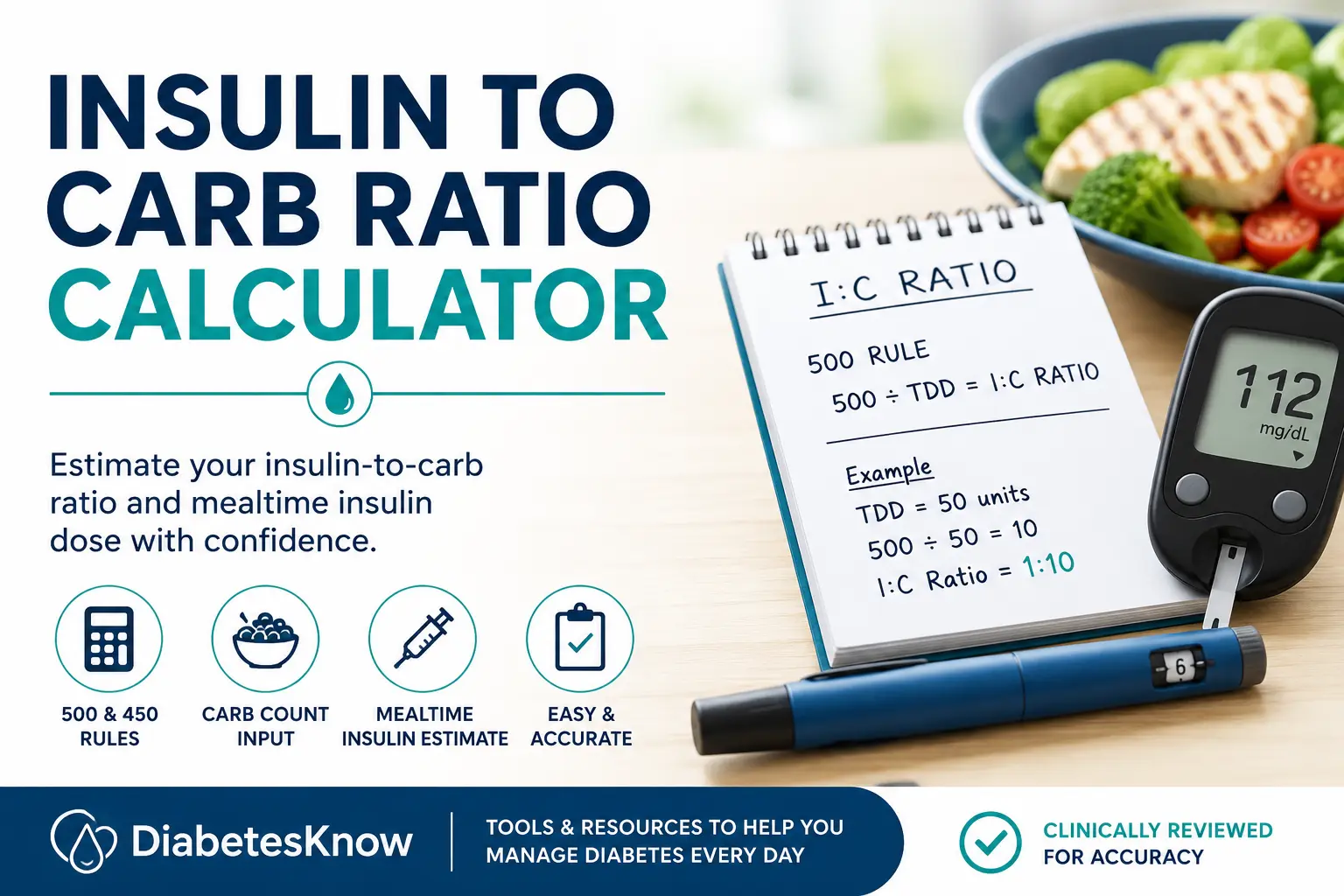
- The 500 Rule gives you a starting point: To estimate your I:C ratio, divide 500 by your total daily dose (TDD) of insulin. This is known as the “500 rule.” Use that number as a starting point, then refine with your care team and real meal data.
- Most adults fall in a predictable range: Most adults with type 1 diabetes have ratios between 1:5 and 1:15. Type 2 patients on mealtime insulin often land between 1:10 and 1:25 due to residual endogenous secretion. Therefore, if your post-meal readings consistently land outside these patterns, flag it with your doctor.
- Fiber is not the same as carbs: When counting carbs for insulin subtract the grams of dietary fiber from the total carbohydrate. Your body cannot digest fiber, so it does not raise blood sugar. Skipping this step leads to over-dosing and dangerous lows.
- The 2026 ADA guidelines now formally expand nutrition guidance: The ADA’s 2026 Standards of Care expanded recommendations to include evidence on macronutrient composition, carbohydrate, fat, and protein, and its impact on insulin dosing, glycemic excursions, and long-term outcomes. This makes accurate carb ratio calculations more central to care than ever.
Quick-Start Prioritization Framework
| Situation | Best Starting Action | Effort Level | Time to See Results |
|---|---|---|---|
| Newly on mealtime insulin | Use the 500 Rule to get a starting ratio | Low | Days |
| Consistent post-meal highs | Log meals and test 2 hours after eating | Medium | 1-2 weeks |
| Inconsistent daily readings | Use a 3-7 day average TDD for recalculation | Medium | 1-2 weeks |
| High-fat or high-protein meals | Adjust dose by 20-30% above carb-only dose | Medium | Immediate |
| Using an insulin pump | Program multiple time-segmented ICR values | High | 2-4 weeks |
Start here if you’re:
- New to carb counting: Use the 500 Rule to estimate your ratio, then validate it with 3-5 days of logged post-meal readings.
- Seeing post-meal spikes after pizza or fatty meals: Check whether fat content is delaying glucose absorption and adjust accordingly.
- Managing with a pump: Work with your care team to set separate morning, midday, and evening ratios for tighter control.
Insulin-to-Carb Ratio Calculator
Enter your total daily insulin dose to estimate how many grams of carbohydrate may be covered by one unit of insulin. Results update instantly as you type.
Enter Your Information
Total daily dose includes all basal and mealtime insulin taken during a typical 24-hour period.
Include both basal and bolus insulin. Do not enter only your long-acting or basal dose.
Enter a total daily dose between 1 and 500 units.
Use the method recommended by your diabetes care professional. The 500 Rule is selected by default.
This optional field shows the meal-insulin amount produced by the estimated ratio. It does not include a glucose correction.
Enter a carbohydrate amount between 0 and 500 grams.
Estimated Result
Your result appears automatically after you enter a valid daily dose.
Enter your total daily dose
The calculator will display an estimated insulin-to-carbohydrate ratio and explain what the result means.
Estimated insulin-to-carb ratio
1:— 1 unit per — grams of carbohydrate
Calculation
Educational meal estimate
Approximately — units
How the estimate works
The selected rule is divided by your total daily insulin dose. For example, 500 ÷ 50 units produces an estimated ratio of 1 unit for every 10 grams of carbohydrate.
Why your actual ratio may differ
Insulin needs can change with meal timing, activity, stress, illness, hormones, medication, insulin sensitivity, and other individual factors. Some people use different ratios at breakfast, lunch, and dinner.
What an Insulin to Carb Ratio Calculator Actually Does
The bolus dose for food coverage is prescribed as an insulin to carbohydrate ratio (I:C). The insulin to carbohydrate ratio represents how many grams of carbohydrate are covered or disposed of by 1 unit of insulin. In practical terms, this is the formula that tells you how much rapid-acting insulin to take before every meal.
If your I:C ratio is 1:15, that means you take 1 unit of fast-acting insulin for every 15 grams of carbohydrate you are eating or drinking. [3] So, if you eat and drink 45 grams of carbs for breakfast, you will then take 3 units of rapid-acting insulin for your meal.
After dosing, compare your before-meal and 2-hour post-meal glucose readings with standard Blood Sugar Charts to help determine whether your insulin-to-carb ratio is providing appropriate glucose control.
An insulin to carb ratio calculator removes the guesswork from that math. You enter your carb count and your known ratio, and it produces a bolus recommendation. [9] Most insulin pumps now do this math automatically when recommending a bolus of insulin. For people on multiple daily injections, however, the math happens manually at every meal, which is where a reliable calculator becomes a daily necessity.
The 500 Rule: Finding Your Starting Ratio
The core formula is: ICR = Divisor divided by TDD, where the divisor is 500 (standard for multiple daily injections) or 450 (sometimes used for pump therapy). [3] TDD is the sum of all basal and bolus insulin over 24 hours.
If insulin intake varies from one day to the next, it is recommended to calculate the average over 3-4 days before running the formula. This smooths out outliers caused by illness, stress, or unusual activity.

Pro Tip: The 500 Rule and the 450 Rule are population-level starting points, not personalized prescriptions. As diabetes educators often recommend, “the gold-standard method is the 3-day structured test: eat a known carb load for the same meal on 3 consecutive days.” Real-world data from this approach is what actually helps refine your insulin to carb ratio.
Why Fiber, Fat, and Protein All Matter to Your Ratio
One of the biggest mistakes people make with carb counting is treating all grams of carbohydrate equally. [4] They are not.
Fiber Reduces Your Effective Carb Count
When counting carbs for insulin subtract the grams of dietary fiber from the total carbohydrate. If a food has 10 grams of total carbohydrate and 5 grams of fiber, you count it as 5 grams. Fiber is listed on the nutrition label under total carbohydrates, so many people miss this step and routinely overdose. That leads to more lows, and more frustration.
Fat Delays Glucose and Throws Off Your Timing
A 60-gram carb pizza and a 60-gram carb bowl of rice have the same carb content but wildly different glucose profiles. Fat delays gastric emptying by 30-90 minutes, causing a late glucose rise that a simple ICR-based bolus cannot fully catch.
Adding fat and protein to a meal significantly raises blood glucose levels, to achieve target glucose control, 65% more insulin is needed with a high-fat, high-protein meal, best given as a “dual wave” over 2.5 hours. Therefore, if you’re eating a high-fat dinner and your ratio-based dose seems to work perfectly at first but you wake up high, fat delay is the likely culprit.
Protein Has a Delayed, Smaller Effect
Protein has a delayed, less dramatic effect. About half of a meal’s protein may eventually convert to glucose, raising blood sugar gradually over about 6 hours. For adults, meals with 20 or more grams of protein may require additional insulin.
How the 2026 ADA Guidelines Change What You Should Be Doing
The 2026 ADA Standards of Care formalized several changes that directly affect how insulin to carb ratios should be calculated and applied. [1]
Macronutrients Now Factor Into Official Guidance
The 2026 ADA guidelines now formally direct clinicians to provide education on the glycemic impact of carbohydrate, fat, and protein, tailored to an individual’s needs, insulin plan, and preferences for care, to optimize mealtime insulin dosing. This means your ratio is no longer just about carbs on paper, the full meal composition is now part of the official conversation. [6]
CGM Is Now Recommended at Diabetes Onset
The 2026 updates include expanded recommendations for technology use, including continuous glucose monitoring (CGM) and automated insulin delivery (AID). CGM use is now recommended at the onset of diabetes for those who use insulin, and for anyone at risk of hypoglycemia or who would benefit from CGM in supporting blood sugar management. While day-to-day glucose readings help fine-tune insulin dosing, your A1C Calculator provides another valuable way to monitor how those dosing decisions affect your average blood sugar over the previous two to three months.
This matters because research published in NCBI’s Endotext [7] review of CGM technology found that a 2025 meta-analysis of six randomized controlled trials comparing hybrid CGM protocols with standard monitoring demonstrated a 7.2% increase in time in range, a 3.7% reduction in time above 250 mg/dL, and clinically meaningful reductions in hypoglycemia. If you are using an insulin to carb ratio without CGM data to validate it, you are flying partially blind.
Ratio Reviews Should Happen Every 3-6 Months
The 2026 ADA Standards of Care specify that insulin treatment plans and insulin-taking behaviors should be reevaluated at regular intervals, every 3-6 months, and adjusted to incorporate specific factors that affect choice of treatment and ensure achievement of individualized glycemic goals. [5] Your ratio calculated last year may be wrong today if your weight, activity level, medications, or stress levels have shifted.
Three Mistakes That Wreck Your Insulin to Carb Ratio Calculator Results
In my experience working with diabetes education resources, these three errors account for the majority of unexplained post-meal highs and lows. [8]
Mistake 1: Using a single-day TDD. The calculator assumes your TDD is reasonably stable, use a 3-7 day average, and that you are using rapid-acting insulin analogs. One unusual day, a sick day, a high-stress day, a rest day after intense exercise, will skew the entire calculation.
Mistake 2: Ignoring insulin on board. Active insulin, also called insulin on board, is a variable people sometimes forget when hurrying to manage their glucose. If there are two units of insulin already active in your system, adding insulin for a meal may drop your glucose too low.
Mistake 3: Copying someone else’s ratio. Copying someone else’s ratio is a common mistake. Two people with identical TDDs of 50 units can have ICRs of 1:8 and 1:13 because of differences in insulin clearance, hepatic glucose output, and beta-cell reserve. The 500 rule is a population-level heuristic, not an individual prescription.
Insulin to Carb Ratio Calculator Frequently Asked Questions
What to Do Right Now
If you are managing diabetes with mealtime insulin and have not reviewed your I:C ratio recently, the 2026 ADA guidelines make a clear case for acting now. Calculate your 3-7 day average TDD, apply the 500 Rule to get a starting point, and bring that number to your next endocrinology or diabetes educator visit. [7] Pair it with post-meal glucose logs and, ideally, CGM data. The American Diabetes Association’s carb counting resource and the The bolus dose for food coverage are both free, high-quality starting points for building your calculation skills.
Your ratio is a living number. Treat it that way.
References
- American Diabetes Association Professional Practice Committee. Standards of Care in Diabetes—2026. Diabetes Care. Volume 49, Supplement 1.
- American Diabetes Association. American Diabetes Association Official Website.
- Healthline. How to Dose Insulin for Carb Ratios and Corrections.
- University of California, San Francisco Diabetes Teaching Center. Calculating Insulin Dose.
- Guideline Central. Diabetes Standards of Care 2026.
- diaTribe. Your Guide to the 2026 ADA Standards of Care.
- Feingold KR, Anawalt B, Blackman MR, et al., editors. Endotext. South Dartmouth, MA: MDText.com, Inc.; National Center for Biotechnology Information.
- Mayo Clinic. Diabetes: Diagnosis and Treatment.
- American Diabetes Association. How to Count Carbs for Diabetes.








Leave a Reply