
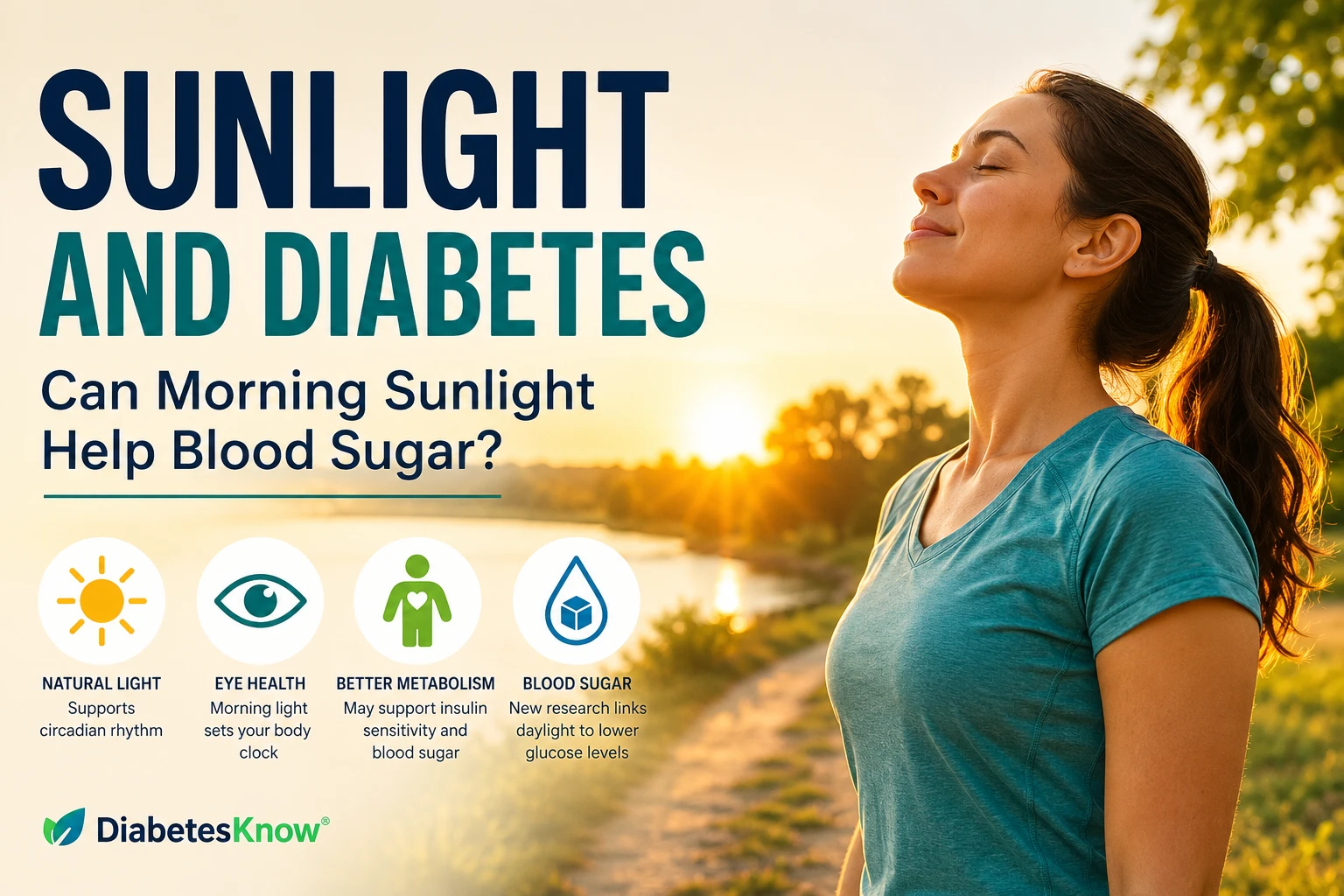
Sunlight and Diabetes: Can Morning Sunlight Help Blood Sugar?
Getting outside in the morning may do more than help you wake up. Research on sunlight and diabetes suggests that natural light exposure may influence blood sugar, circadian rhythms and metabolism. New studies have found promising links between daylight exposure and glucose control, particularly in people with type 2 diabetes.
However, sunlight is not a treatment for diabetes, and researchers have not established that a few minutes of morning sun will directly lower blood sugar.
Key Points
- Natural daylight helps regulate your circadian rhythm, which influences sleep, hormones and glucose metabolism.
- A 2026 study found that people with type 2 diabetes spent more time with glucose in the normal range when exposed to natural daylight rather than artificial office lighting.
- Another 2026 study associated greater sunlight exposure with lower blood glucose, particularly during winter.
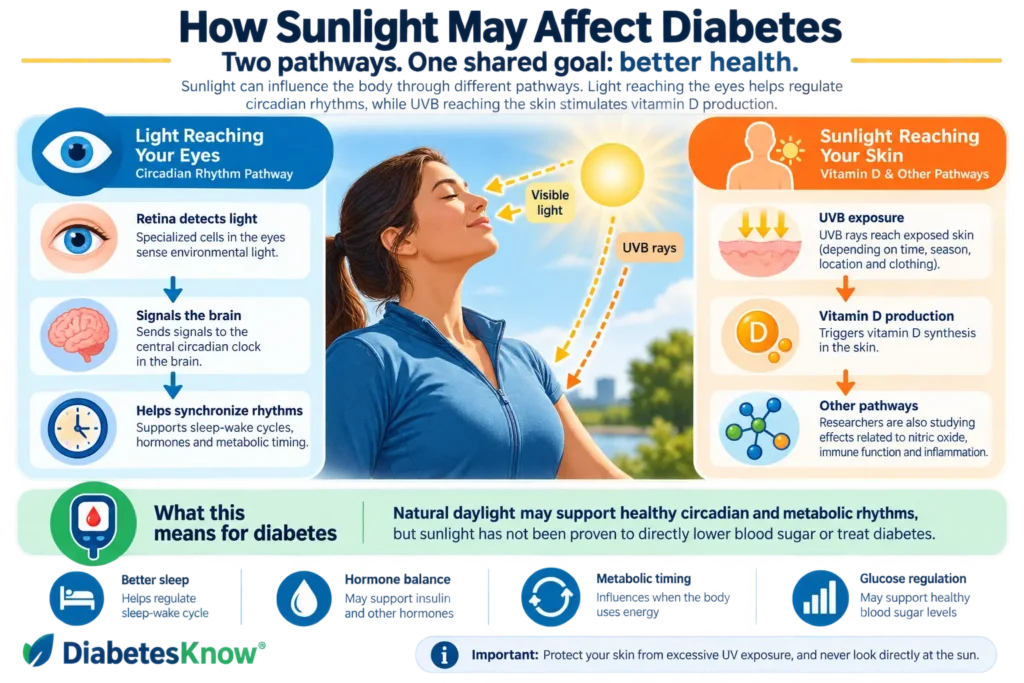
- Light reaching your eyes primarily affects your circadian clock, while sunlight on your skin can stimulate vitamin D production and may have other biological effects.
- Morning sunlight has not been proven to treat diabetes or reliably lower blood sugar.
- Protect your skin from excessive UV exposure, and never look directly at the sun.
Can Sunlight Help With Diabetes?
There is growing evidence that natural daylight may play a supporting role in metabolic health.
A 2026 study published in Scientific Reports examined sunlight exposure, blood glucose and type 2 diabetes using UK Biobank data. Researchers found that greater ambient sunlight exposure was associated with lower blood glucose, with the strongest association appearing during winter.1
The study does not prove that sunlight directly lowers blood sugar. It was observational, and researchers estimated ambient sunlight exposure rather than measuring exactly how much time each participant spent outdoors.
Still, the findings add to evidence suggesting that our daily light environment may influence glucose metabolism.
Sunlight Through Your Eyes vs. Sunlight on Your Skin
The body responds to sunlight in different ways depending on whether it reaches your eyes or your skin.
Light Through Your Eyes
Your eyes provide one of the strongest pathways for signaling your brain’s circadian clock—the internal system that helps coordinate your approximately 24-hour sleep-wake cycle.
Your circadian system also helps regulate processes involved in glucose metabolism, including insulin secretion, eating patterns and how different tissues use energy. Circadian disruption has been associated with impaired glucose regulation and insulin resistance.2
This is one reason getting outdoor light during the daytime, particularly after waking, may be useful for maintaining a healthy day-night rhythm.
You do not need to stare at the sun. Never look directly at the sun, which can damage your eyes.
Sunlight on Your Skin
Sunlight reaching the skin has different effects.
Ultraviolet B (UVB) radiation helps the skin produce vitamin D. Researchers have also investigated whether sunlight may influence cardiovascular and metabolic health through other pathways.
A systematic review examining sunlight and type 2 diabetes found moderate evidence linking recreational sun exposure with lower odds of developing type 2 diabetes. However, the researchers emphasized that high-level evidence was lacking and proposed that sunlight could have biological effects beyond vitamin D alone.3
That means vitamin D may be part of the sunlight-diabetes relationship, but it probably does not explain the entire picture.
How Morning Sunlight Affects Your Circadian Rhythm
Morning light provides a strong environmental signal that daytime has begun.
Light detected by your eyes communicates with the brain’s central circadian clock, helping synchronize biological rhythms with the natural light-dark cycle. This influences when you feel awake and sleepy as well as the timing of hormones and metabolic processes.
For people with diabetes, this connection is interesting because circadian misalignment has been linked with impaired insulin sensitivity and glucose metabolism.
But there is an important distinction:
Evidence that light regulates circadian rhythms does not mean morning sunlight has been proven to lower blood sugar.
Morning outdoor light is better viewed as one part of maintaining a healthy circadian rhythm rather than as a glucose-lowering therapy.
What New Research Says About Sunlight and Blood Sugar
Two studies published in 2026 have made the connection between daylight and glucose particularly interesting.
In a randomized crossover study published in Cell Metabolism, 13 people with type 2 diabetes spent 4.5 days exposed to either natural daylight through windows or constant artificial office lighting.
Continuous glucose monitoring showed that participants spent more time with glucose in the normal range during the natural daylight condition. If you monitor glucose at home, our blood sugar charts can help you compare readings with commonly used glucose ranges. Researchers also observed greater reliance on fat oxidation and changes involving the skeletal muscle circadian clock.4
The study was small, so larger and longer trials are needed.
Separately, the August 2026 Scientific Reports study found that higher ambient sunlight exposure was associated with lower glucose levels, particularly in winter.
Together, these studies strengthen the case for investigating daylight as a factor in metabolic health—but they do not establish sunlight as a diabetes treatment.
Is Vitamin D the Reason Sunlight May Help?
Vitamin D is often the first explanation given for the possible health benefits of sunlight, but the relationship is more complicated.
UVB radiation triggers vitamin D production in exposed skin, and low vitamin D levels have frequently been associated with type 2 diabetes. However, associations between vitamin D status and diabetes do not prove that increasing sun exposure will improve blood sugar.
Researchers are investigating other potential effects of sunlight as well, including pathways involving nitric oxide, circadian regulation and cellular energy metabolism.
For now, it is more accurate to think of sunlight as a complex environmental exposure rather than simply a way to increase vitamin D.
Does Sunlight Help Type 1 and Type 2 Diabetes Differently?
Most of the direct research on sunlight, daylight and glucose control has focused on type 2 diabetes or the risk of developing type 2 diabetes.
There is not enough evidence to say that sunlight improves glucose control in people with type 1 diabetes.
People with type 1 diabetes can still benefit from healthy sleep, regular physical activity and maintaining a consistent circadian rhythm, but sunlight does not replace insulin or other aspects of diabetes management.
The same principle applies to type 2 diabetes: natural daylight may support metabolic health, but it should complement—not replace—medication, nutrition, exercise, glucose monitoring and other aspects of blood sugar management.
How to Get Morning Light Safely
Getting morning light does not require sunbathing or looking directly into the sun.
A simple approach is to spend some time outdoors after waking when your schedule and weather allow. Normal outdoor daylight provides a much stronger light signal than typical indoor lighting, even without staring toward the sun.
There is currently no established number of minutes of morning sunlight needed to improve diabetes or lower blood sugar, so claims that everyone needs a specific 10-, 20- or 30-minute “dose” for diabetes are not supported by strong clinical evidence.
Sun exposure also carries risks. Too much ultraviolet radiation can damage skin cells and increase skin cancer risk. The CDC recommends using sun protection when UV exposure is significant, including shade, protective clothing, sunglasses and sunscreen.5
You don’t need to damage your skin to benefit from being outdoors.
The Bottom Line
The relationship between sunlight and diabetes is becoming an interesting area of research.
Natural daylight helps regulate the body’s circadian clock, and recent research suggests daylight exposure may also influence glucose metabolism. New 2026 studies have found better glucose control under natural daylight conditions and associations between greater sunlight exposure and lower blood glucose.
But the evidence does not show that morning sunlight is a treatment for diabetes or that sitting in the sun will reliably lower your glucose.
If you’re tracking longer-term glucose control, the A1C Calculator can help you compare A1C with estimated average glucose (eAG).
The practical takeaway is simpler: regular exposure to natural daytime light—especially as part of a consistent morning and daytime routine—may support healthy circadian and metabolic rhythms without replacing proven diabetes care.
Frequently Asked Questions


References
- Stevenson AC, Weller RB, Lindqvist P, et al. Sunlight exposure is associated with lower blood glucose levels and type 2 diabetes. Scientific Reports. 2026. https://www.nature.com/articles/s41598-026-66100-4 [↩]
- Speksnijder EM, et al. Circadian desynchrony and glucose metabolism. Journal of Pineal Research. 2024. https://onlinelibrary.wiley.com/doi/full/10.1111/jpi.12956 [↩]
- Shore-Lorenti C, et al. Shining the light on Sunshine: a systematic review of the influence of sun exposure on type 2 diabetes mellitus-related outcomes. Clinical Endocrinology. 2014. https://pubmed.ncbi.nlm.nih.gov/25066830/ [↩]
- Harmsen JF, et al. Natural daylight during office hours improves glucose control and whole-body substrate metabolism. Cell Metabolism. 2026. https://pubmed.ncbi.nlm.nih.gov/41418772/ [↩]
- Centers for Disease Control and Prevention. Sun Safety Facts. https://www.cdc.gov/skin-cancer/sun-safety/ [↩]





Leave a Reply